
Explainer · Surgery & records
What is deep infiltrating endometriosis?
Deep endometriosis grows into the tissue and organs beneath the pelvic lining. How it differs from other types, how UK specialists confirm it, and how it is treated.
Key takeaways
- Deep endometriosis grows into the tissue beneath the pelvic lining, or into organs such as the bowel, bladder or ureters — it is not only on the surface.
- It is one of three types, alongside superficial peritoneal disease and ovarian endometriomas, and many people have more than one type at the same time.
- How much pain you are in does not tell you how deep or extensive the disease is. Superficial endometriosis can be just as painful.
- NICE says anyone with suspected or confirmed deep endometriosis should be referred to a specialist endometriosis centre, not general gynaecology.
- A normal ultrasound or MRI does not rule endometriosis out. Ask what was looked at, and who interpreted it.
Endometriosis is a condition where tissue similar to the lining of the womb grows outside the womb, usually with inflammation around it. It affects around 1 in 10 women and people assigned female at birth of reproductive age in the UK.
Not all endometriosis behaves the same way, and the differences matter — they change which scan is useful, which specialist you should see, and what surgery would involve. Deep endometriosis is the type that grows into tissue and organs rather than sitting on the surface.
What "deep" actually means
Deep endometriosis, often called deep infiltrating endometriosis or DIE, is disease that involves the space beneath the pelvic lining or the wall of a pelvic organ.
You will still see it defined as endometriosis that grows more than 5mm below the surface of the peritoneum, the thin membrane lining the pelvis. That measurement came from older research. In 2021, an international working group of the main gynaecology and endometriosis societies removed it from the formal definition, because the depth of a lesion cannot be measured reliably in practice. The current definition is based on what the disease involves rather than how many millimetres deep it goes.
Specialists increasingly use the shorter term "deep endometriosis". If your notes say DIE, deep endometriosis, or deeply infiltrating endometriosis, these mean the same thing.
The three types, and why people have more than one
Superficial peritoneal endometriosis is the most common type. The lesions are flat and sit on the pelvic lining without growing into the tissue underneath.
Ovarian endometriomas are cysts in the ovary containing old blood, which is why they are sometimes called chocolate cysts. Most people with an endometrioma also have disease elsewhere in the pelvis.
Deep endometriosis is the least common of the three. It is also the most likely to involve other organs, which is why it usually needs a team rather than a single surgeon.
These are not alternatives. Many people have two or three types at once, and finding one should prompt a look for the others.
Where deep endometriosis is usually found
The most common site by a wide margin is the uterosacral ligaments, the supporting tissue behind the womb. Studies of surgical and MRI series consistently put this first.
Other common sites are the area behind the cervix, the rectovaginal septum and the vagina, and the bowel. Where the bowel is involved, around nine out of ten cases affect the rectum or sigmoid colon — the section closest to the back of the womb.
The bladder and the ureters, the tubes carrying urine from the kidneys, are involved less often. Estimates for urinary tract involvement sit at roughly 1 to 6 percent of all endometriosis. This is worth knowing about for one specific reason: endometriosis affecting a ureter can cause no symptoms at all while gradually obstructing it. That is why a specialist assessing deep disease will usually want to check the kidneys and ureters, not just the pelvis.
Deep endometriosis is often multifocal, meaning several separate areas are involved at once. Reported figures for bowel involvement range from under 4 percent to over a third depending on which patients were studied, so treat any single percentage you read with caution.
Symptoms that point towards deep disease
No symptom proves deep endometriosis, but some patterns make specialists look harder:
Pain deep inside during or after sex, rather than at the entrance.
Pain on opening your bowels, particularly around your period.
Cyclical bowel symptoms — bloating, urgency, constipation or diarrhoea, or bleeding from the back passage that tracks with your cycle.
Cyclical urinary symptoms, including pain passing urine or blood in your urine around your period.
Pain that is present between periods, not only during them.
Symptoms that follow your cycle are the important signal. Bowel and bladder symptoms that come and go with your period are commonly mistaken for IBS or recurrent urinary infections, and that mistake is one of the main reasons diagnosis takes so long.
View Mermaid source
flowchart TD
    Symptoms["Cyclical pelvic, bowel or bladder pain"] --> GP["GP assessment and pelvic examination"]
    GP --> TVS["Transvaginal ultrasound arranged by GP practice"]
    GP --> Treat["Initial pain treatment started in parallel"]
    TVS --> Findings{"Endometrioma, deep endometriosis, or disease outside the pelvis?"}
    Findings -->|Yes| Centre["Refer to specialist endometriosis centre"]
    Findings -->|No, symptoms persist| Gynae["Refer to gynaecology service"]
    Centre --> Mapping["Specialist ultrasound or pelvic MRI to map extent"]
    Mapping --> MDT["Multidisciplinary plan: medical, surgical or both"]
    Gynae --> Lap["Laparoscopy may still be considered even if scans were normal"]
How deep endometriosis is diagnosed in the UK
NICE updated its endometriosis guideline (NG73) in November 2024, and the pathway changed in ways that are not yet reflected in a lot of the information online.
Your GP should offer you a transvaginal ultrasound if endometriosis is suspected, even if your physical examination was normal, and your GP practice should arrange it. Investigations, referral and starting treatment for your pain are meant to happen alongside each other rather than one after another.
If an endometrioma, deep endometriosis involving the bowel, bladder or ureter, or endometriosis outside the pelvis is suspected or confirmed, NICE says you should be referred to a specialist endometriosis service — an endometriosis centre — rather than a general gynaecology clinic. The 2024 update strengthened this from "consider referring" to "refer". If you are 17 or under, referral should be to paediatric and adolescent gynaecology or a specialist centre.
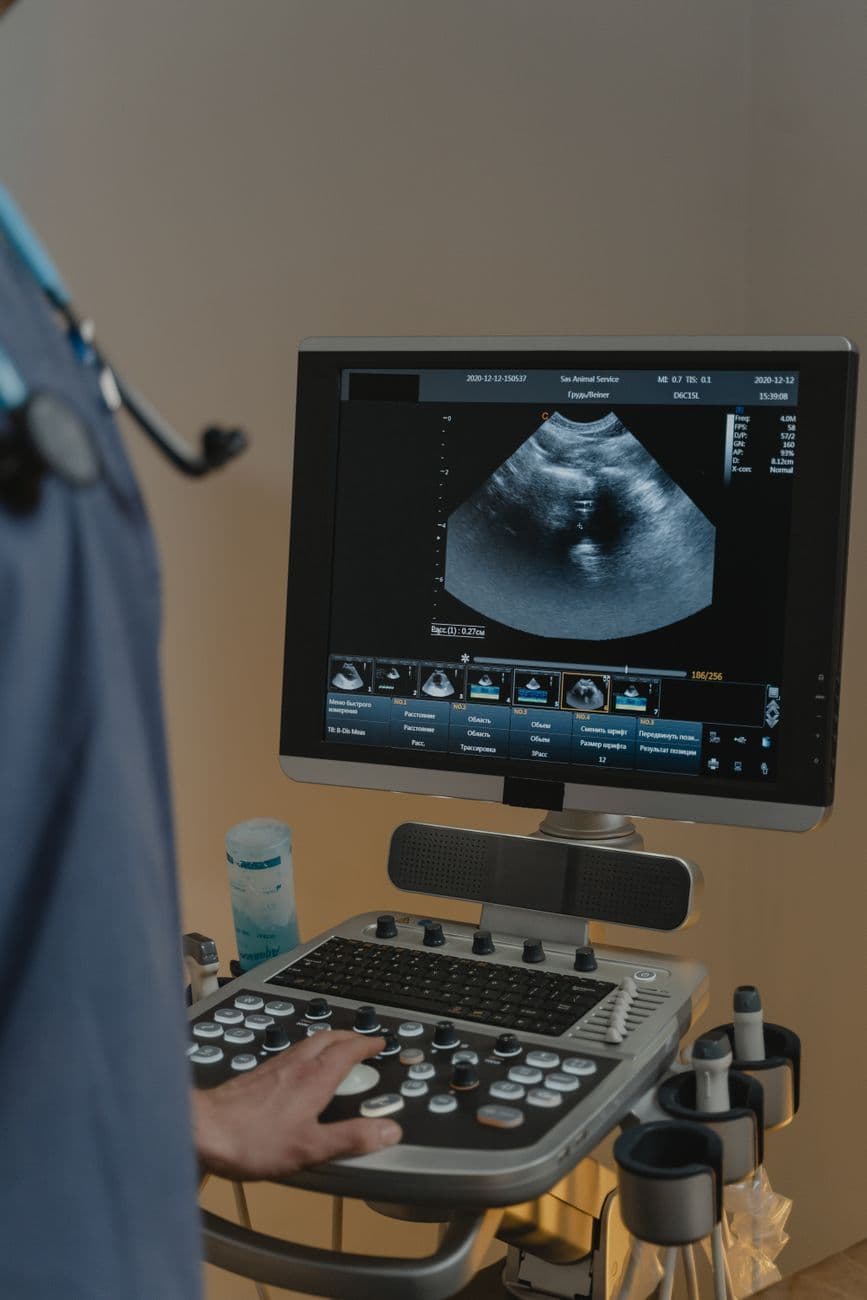
To confirm deep endometriosis and map how far it extends, specialists use a specialist transvaginal ultrasound or a pelvic MRI, planned and reported by someone with specific expertise in gynaecological imaging. This is not the same as a routine scan, and expertise is the variable that matters most.
Two things are worth holding onto. A normal ultrasound or MRI does not rule endometriosis out, and NICE says a diagnostic laparoscopy can still be considered even when imaging was normal. But laparoscopy is no longer required before you can be diagnosed with deep endometriosis or start treatment. Imaging alone can be enough.
What "stage 4" does and does not mean
Endometriosis is often staged from I to IV using the revised ASRM system, which scores what a surgeon finds. Specialists may also use a separate system to describe exactly where deep disease sits anatomically.
Stage does not measure pain. Someone with stage I disease can be in more pain than someone with stage IV. The staging systems were designed largely around fertility outcomes, not symptoms, and they correlate poorly with how you feel. If you have been told you have severe disease and mild symptoms, or the reverse, neither is a contradiction.
How deep endometriosis is treated
Treatment is usually a combination, and the right one depends on your symptoms, whether you are trying to conceive, and where the disease is.
Hormonal treatment aims to control symptoms. Options include the combined pill, progestogens, the hormonal coil, and GnRH agonists or antagonists with add-back therapy. NICE recommended two newer combined treatments for endometriosis symptoms in 2025 for adults who have already had medical or surgical treatment. Hormonal treatment can be very effective for pain, but it manages the disease rather than removing deep nodules.
Surgery for deep endometriosis is specialist work. Where the bowel is involved, there are broadly three approaches: shaving the lesion off the bowel surface, removing a disc of bowel wall, or removing a segment of bowel and rejoining it. Shaving preserves the most tissue but has the highest rate of the disease coming back; segmental resection has the lowest recurrence but carries more risk of complications and of longer-term bowel function problems. There is no single correct answer — the choice depends on the size, depth and number of lesions, and on the surgical team's experience. This is a conversation to have properly before consenting.
Removing the womb does not remove endometriosis that is growing elsewhere in the pelvis. A hysterectomy may be part of a plan for some people, but on its own it is not a cure for deep disease.
Endometriosis can also affect fertility, and NICE published updated fertility guidance in March 2026 with recommendations specific to endometriosis. If you are thinking about pregnancy, raise it before surgery is planned rather than after — it can change what is recommended.
Why the specialist centre matters
UK specialist endometriosis centres are accredited by the British Society for Gynaecological Endoscopy. To be accredited, a centre must have gynaecologists with specific expertise in severe endometriosis who each do a minimum caseload every year, at least one named colorectal surgeon who joins complex bowel cases and multidisciplinary meetings, and named urology, radiology, fertility and pain specialists supporting the service.
That structure is the point. Deep endometriosis frequently crosses into bowel and urinary territory, and being operated on somewhere without that team on hand is how incomplete surgery happens.
The average time to an endometriosis diagnosis in the UK is now 9 years and 4 months, and 11 years for people from ethnically diverse communities — figures that have got worse, not better, over the last decade. Knowing which referral you are asking for, and why, is one of the few parts of this you can influence.
When to ask for a specialist centre referral
Based on NICE's referral criteria, it is reasonable to ask your GP directly for a referral to a specialist endometriosis centre if you have suspected or confirmed endometriosis affecting your bowel, bladder or ureter, an ovarian endometrioma, or endometriosis outside the pelvis.
Ask for the reason for the referral to be recorded in your notes. If a referral is declined, ask for that decision in writing.
Medically reviewed by
DocMap editorial team · Patient education
Last reviewed 4 August 2026
DocMap publishes practical guides to help UK patients navigate endometriosis care.
About the author
DocMap editorial team · Patient education
DocMap publishes practical guides to help UK patients navigate endometriosis care.
Not sure where to start?
Use Guided Care to map your symptoms and see sensible next steps — NHS and private routes included.
Check your pathway